Baby Boomers
Why write about that crotchety old generation of peace-lovin’, drug-poppin’, hair-raisin’ long-haired ‘60s flower children who turned into anything but those early versions of themselves? Why? Because I’m NOT writing about them. This is, thankfully, about the boom of baby birds I witnessed this Spring. And, yes, I can say all those nasty things about those crotchety old “Baby Boomers” because – gasp! – I am one of them! But let’s stick with the cute baby boomers for now, shall we?
Last month, I showed a sequence of American Avocets mating (if you missed it click here). Here is the result of mating, a cute fuzzy mini-Avocet. It is not the offspring of the pair that mated in my previous post, but it was at the same location as that other pair. There had been three mated pairs of Avocets there and this one was an early hatcher from early breeders. (As always, please click on any image to view larger)
Above - Fuzzy little baby American Avocet with its reflection in the water
I always enjoy watching baby owlets as they observe the big, unknown world wide-eyed and curious. Just so you know, I am especially careful around baby owlets so as not to stress them. I follow all Audubon Society and NANPA guidelines for ethical bird photography (especially nests) as well as I have a few guidelines of my own. Mainly, I photograph from a distance using a minimum 700mm lenses (500mm with a 1.4x teleconverter) plus the final product is cropped so the photo will always look like I am MUCH closer than I really am.
This Spring I visited a repeat site of one nest of Great-horned Owlets plus I actually found a nest all on my own!
Above - FOUR! baby Great-horned Owlets in their tree cavity nest. Mom is deservedly catching a short nap.
Above - One of the baby owlets has started the process called “branching” of leaving the nest and walking on branches. Soon it will be flying off the branches, too.
Above - A pair of Great-horned Owlets had just fledged and I was lucky to find them in a nearby tree.
Babies are not always the most graceful as you can see in this short video of the same group above as one tries to maneuver around.
Above - Great-horned owlet clumsily jumps from a branch to its nest
An Eastern Screech Owl pair recently fledged babies nearby, too. That nest I never would have found without my friend Shelley who seems to know of every nesting site in our metro area. They already were just about fully fledged by the time I was able to get there and photograph and video them.
Above - You can barely see this pair of Eastern Screech Owlet siblings in a tree that they had fledged to. Mom and Dad both stay nearby until they are truly independent.
Above - A baby Eastern Screech Owl is fascinated by a bug
And sometimes you find equally interesting but unintended subjects WHILE photographing what you were looking for. Such was the case here when Shelley pointed out a racoon nest right next to the Screech Owl nest. Here is a 10-second video I took of that racoon nest that went very viral on Instagram.
Above - A baby racoon poos its head up for a few seconds and then changes its mind
And right next to the Screech Owl and Racoon nests were a pair of busy Blue Jays building a nest to prepare for their babies. This was a busy corner of the world all at one time!
Above - A Blue Jay with a mouthful of nesting material flies right by me. They both made several trips to decorate their nest.
The biggest surprise of all this Spring was coming across not one, but TWO Wood Duck broods. In all my years here I had never seen any Wood Duck chicks. I visited two small ponds I enjoy going to and within about a month of each other both were populated with these fuzzy little creatures.
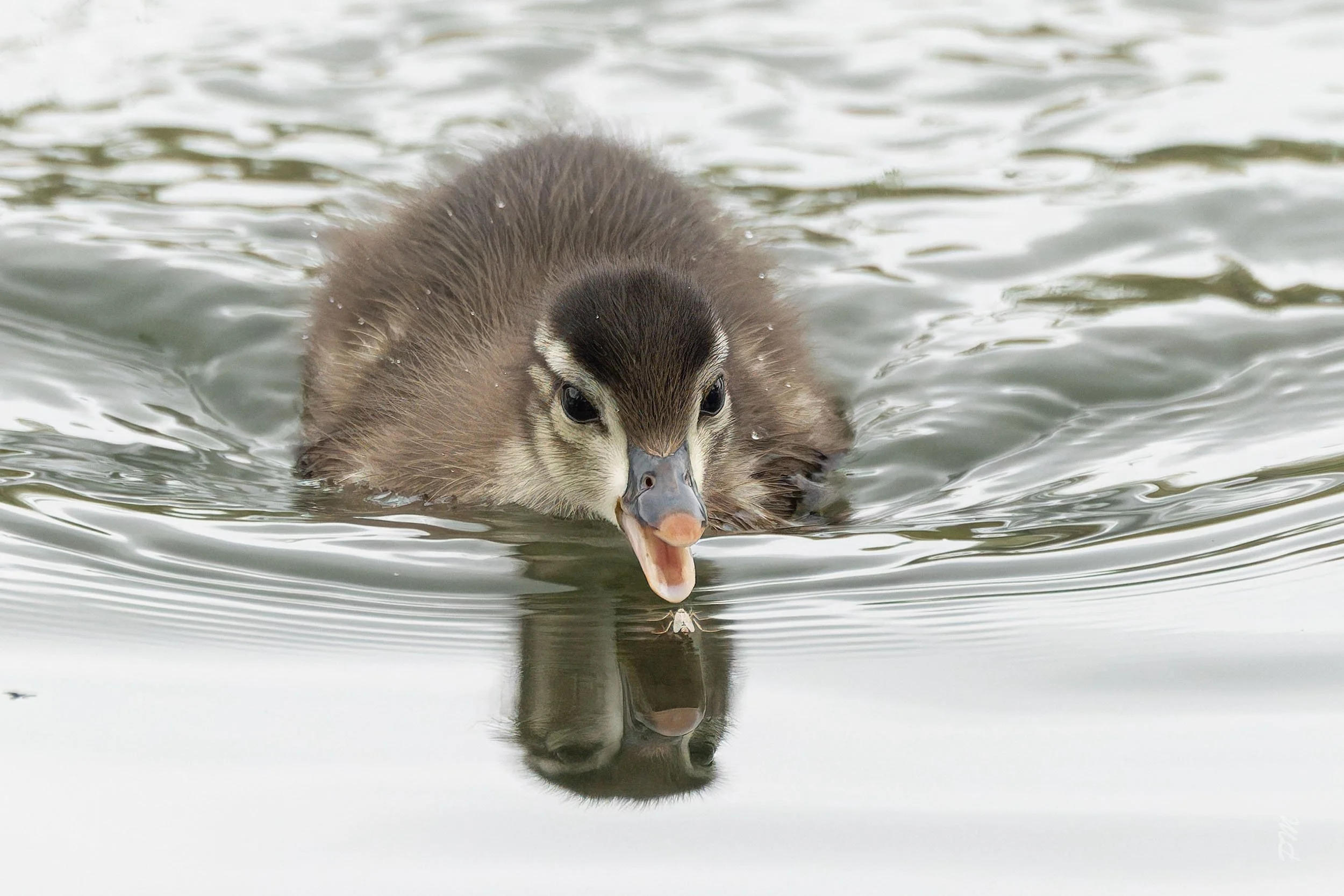
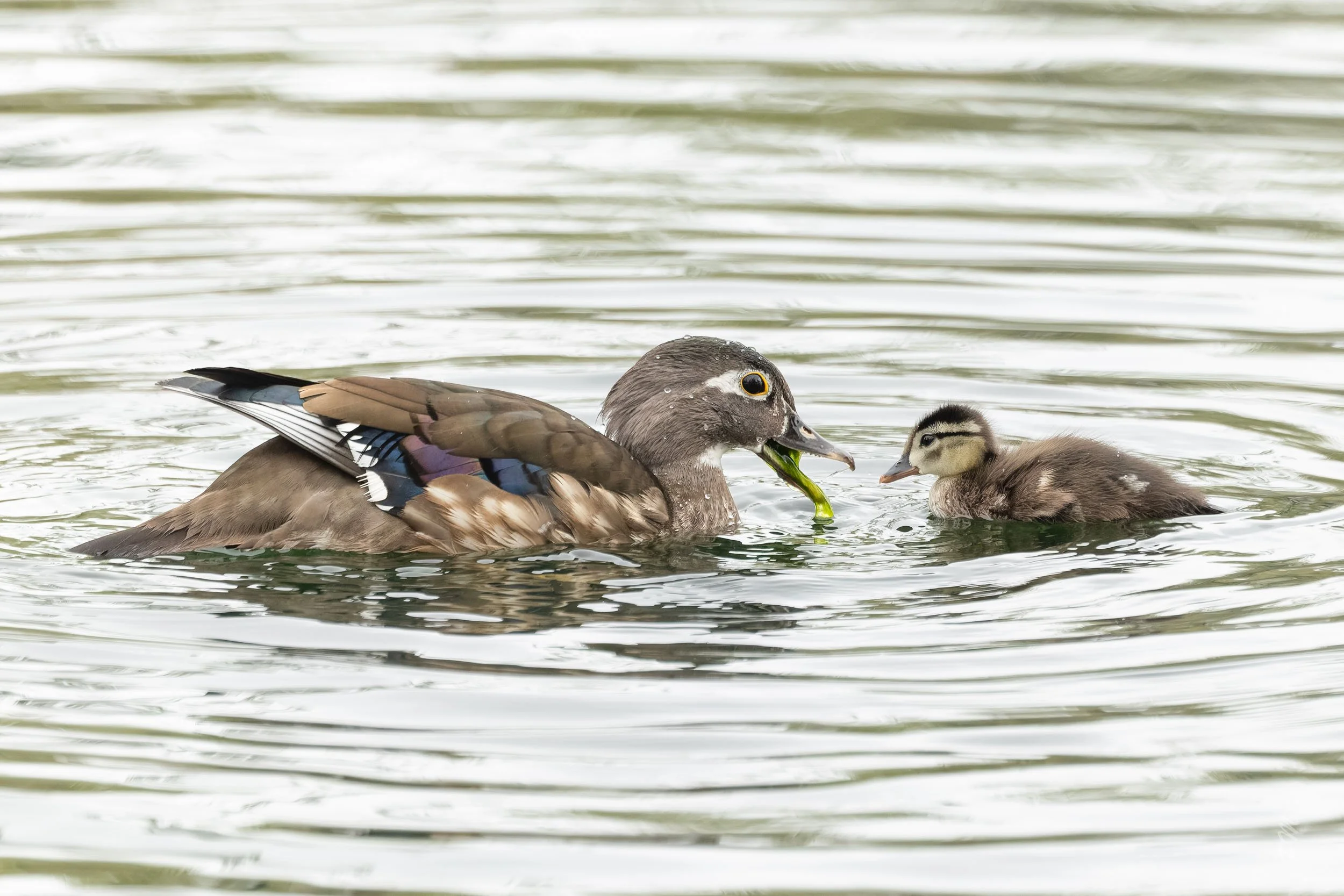
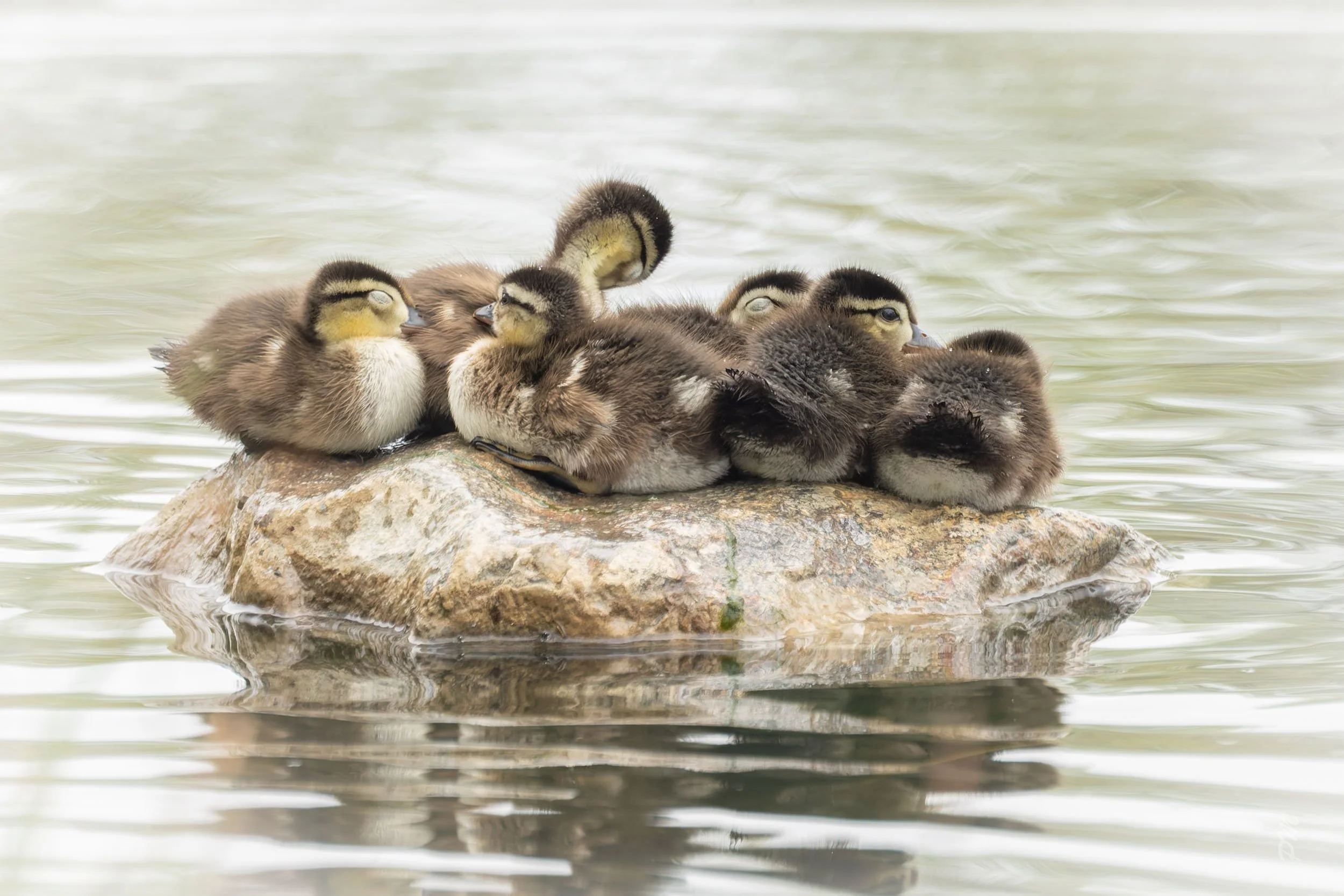
Above - This baby Wood Duck obviously loves its mommy!
Cormorants are rather prolific in the propagation of their species and generally nest in colonies that are so noisy they can often be heard miles away (an exaggeration but you get the point). Below is an example of one nest among dozens at one of two Cormorant rookeries I visited this Spring.
Above - Double-crested Cormorants raise their babies in colonies called rookeries that have multiple nests. Here is one of those nests with two babies looking for a meal from Mom.
I also recently stumbled upon a baby Kildeer only because I saw its mother doing a “broken wing” performance which told me a baby was nearby. When a mother Kildeer feels a baby might be threatened (there were some bicyclists nearby trying to photograph her), she will run off the opposite way of the baby, sit down on the ground, and then hold her wing out as if it is broken to lure the perceived predator to chase her only to have her zip away once the predator commits to following her. Nature is so smart!
Above - An adult Kildeer will feign an injured wing when it thinks its baby may be threatened. This is to lure a predator to her (the mom) in the hopes the predator will get distracted and leave the baby while the adult (obviously not injured) simply flies away from the predator.
Above - And here is that baby Kildeer. Another fuzzball!
Sadly, as with almost all bird species, only a handful of these babies will make it. Predators, parasites, starvation, etc., all combine to make it difficult to see their first birthdays. But let’s enjoy them while we can and ignore those “other” Baby Boomers. Oh, and “HEY, KIDS, GET OFF MY LAWN!”
(Feel free to drop any questions or comments below - I always enjoy hearing from you)